





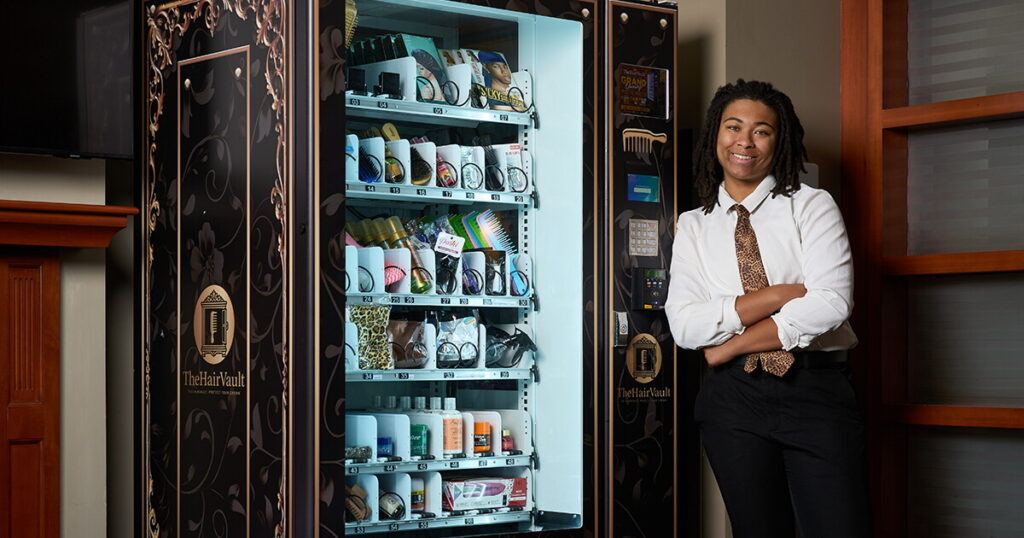
When Zariah Taylor first stepped foot on Washington University’s campus her freshman year, her hair was in an Afro style.At the time, she did not have a car, so she frequented campus stores for hair products to maintain her hairstyle, but she could not find products for naturally textured hair. She immediately decided to dreadlock her hair.“I loc’d my hair while in school, because doing my hair every day just became a struggle,” Taylor said. “It seemed like it was a sacrifice through money or time [and it] was never enough to make me go get these supplies, so if I was going to go to the beauty supply, I had to walk there or catch the bus; that’s too much time for a college student.”The Sam Fox School fashion design senior said many of her friends with curly, wavy or natural hairstyles, who did not have cars, ordered hair supplies online from local stores. However, shipping costs could be higher than the hair products themselves, and delivery times were usually after the event for which they needed their hair done.“I’ve always been outspoken. I’ve always been ambitious. I’ve always been this person who just makes a way, so when I found that these products were not existing on this campus, I started to brainstorm,” Taylor, 21, said.From those many brainstorming sessions, Taylor came up with TheHairVault, a hair vending machine for textured coils that offers 50 hair products. It dispenses full-size and travel size gels, combs, detangling brushes, edge brushes, edge control gel, hydrating shampoos and conditioners, rubber bands, braiding gels, beard oils, natural hair oils, creamy moisturizers, hair grease and more. Most of the products are name brand and priced between $2 and $22. It is located inside WashU’s Village House dining hall at Snow Way Drive and Big Bend Boulevard.The St. Louis native fostered and perfected her hair business venture after numerous visits to WashU’s Skandalaris Center for Interdisciplinary Innovation and Entrepreneurship throughout her college career. However, Taylor has always been a young entrepreneur at heart. She hand-sewed and sold hoodies, bags and face masks while in middle and high school.While at the Skandaralis Center, Taylor bounced ideas off students and staff and thought about what would be right for the university.“I like the fact they let me think … and then I got it,” she said. “Then I started looking for where I can buy a vending machine.”
TheHairVault offers gels, combs, wave brushes, mousse, heat protectant sprays, braiding supplies and moisturizing shampoos and conditioners to students with textured coils at WashU.
She soon entered the center’s pitch competitions prior to her senior year but was not selected. To help expand her company’s reach and prove that her concept would work, she started polling students in different cafeterias about their hair needs.“I had people with textured hair that were Indian, Mexican, mixed race; I had so many different cultures and ethnicities and backgrounds,” she said. “I learned so much.”The multiple conversations changed the trajectory of her business. She learned organically which products would sell, what seasons people need certain goods, and what items to always keep in stock.Taylor’s entrepreneurial journey continued, as she did not let the prior failed pitch competitions deter her. She became a finalist last year but was not successful. Nevertheless, she found another way to get her machine set up and running. Through connections and chance meetings with faculty, department heads and school leaders, she became the only student with a vending machine business on campus.“Most of the way [I’m doing things] I’m doing it is a little different because I’m asking and I’m using connections, but usually what you’re supposed to do is there’s actually a form for these universities, and you put your business information in it, and they look through that list and find you in that list and select you.”I don’t believe in waiting in lines. … I just believe in using your resources. You can put your name on that list, but sometimes, if you ask and you pitch your why, then maybe you don’t have to wait in that line, and you can give people the stuff that they need.”This persistence is what II Luscri admires about Taylor. Luscri is the assistant vice provost for innovation and entrepreneurship and the managing director of the Skandalaris Center for Interdisciplinary Innovation and Entrepreneurship at Washington University. He comes across brilliant, young entrepreneurs every day, but he said Taylor’s pursuit of entrepreneurship is one that many students do not have.“When I look at the success of all of our student entrepreneurs, regardless of industry, persistence is one of those things that’s so important,” he said. “The university is a complex environment, and she navigated that whole system, working with people from Auxiliary Service, from university business services, all the rules and regulations, every business that has to have its licensing and the agreements … and so having gone through that process, she found herself in some meetings with all kinds of different people.”
A patron makes a purchase from TheHairVault vending machine on Sept. 9 at WashU.
WashU’s entrepreneurship center offers students real-world business experience through its Student Enterprise Program, which allows them to gain customers, negotiate contracts and learn how to deal with ongoing business issues. Once students exit the program, they can sell the business to other student investors, continue the business outside the university or close the company. The goal is to open on-campus storefronts and businesses to help fill the students’ and faculty’s unmet needs.Taylor said that being a student entrepreneur has changed her mindset about business and has increased her self-confidence. She funded it from her personal savings account and said she no longer walks around campus with imposter syndrome because she is now the owner of TheHairVault, LLC.“This business makes me carry myself differently,” she said. “TheHairVault holds me accountable for everything that I may fall short on.”Being a business owner has come with challenges for Taylor. During the entrepreneurship center’s pitch competition, she found that people did not understand her business concept and did not immediately see the company’s potential because it did not speak to them. However, she said the difficulties have made her a better businessperson.“I pitched to a lot of white men who didn’t have hair, and they didn’t get it. I spoke to women; they started to get it. I spoke to Black women; they got it,” Taylor said. “Sometimes you identify yourself [with things] in your culture, and if those identifying things are being taken away from you, it’s like, ‘Who am I?’”Taylor hopes TheHairVault instills confidence in whoever purchases items. She is developing plans to open more hair vending machines on campuses across the state.”It’s about identity, culture, community, bringing people together, feeling good about yourself and protecting your crown, your identity and protecting you,” Taylor said. “‘What makes you, you?’ And for me, sometimes, it’s my hair.”
