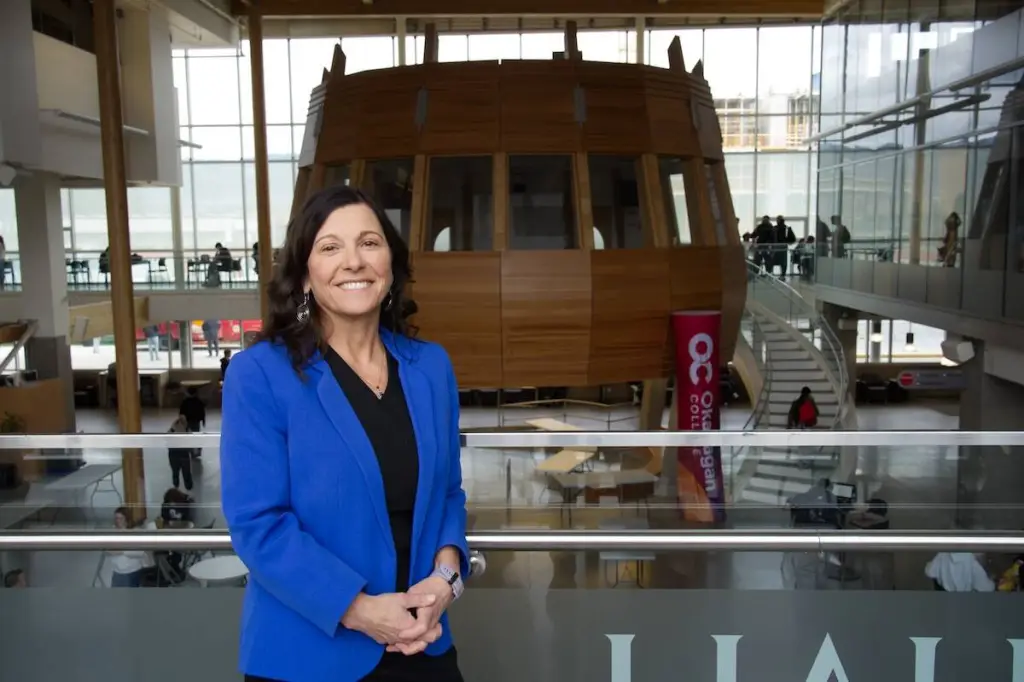
This story of part of Kelowna Capital News’s 34th edition of Women Who Dare (formerly Women in Business).
Kyleen Myrah has had a fair share of accomplishments during her career, and continues to take on challenging tasks, but she remains reserved to not steal the spotlight from her students.
A business professor at Okanagan College (OC) for the past 27 years, Myrah is a prominent figure in the community and won Woman of the Year 2024 at the Rise Awards hosted by Kelowna Women in Business.
One of Myrah’s past students nominated her for the award and rallied up votes from other students who had worked with her as well.
While Myrah shared that she was extremely grateful to be honoured for the award, she expressed being uncomfortable being in the limelight, since she likes to put her students first.
Her intention to give her students the spotlight goes back all the way to 2006, when the student leadership group Enactus was formed. Myrah is the faculty advisor for the group, which uses social entrepreneurship to conduct outreach projects that positively impact the community.
Myrah keeps in touch with the business community through her own company, called KyCo Management, where she coaches and trains business leaders in topics including emotional intelligence, public speaking and strategic planning.
She also works with organizations to help them develop strategies, keeping her connected to the day-to-day of how businesses are working in the community.
Using this knowledge and applying it into her courses she teaches at OC, she keeps her students updated on how to stay relevant to the current climate.
Myrah is a strong believer in leading by example and she follows through on it with the work that she does.
“I think you have to walk the talk, that’s absolutely critical,” said Myrah. “If you are a role model, you have to decide what kind of role model you want to be. If you want people to be in community, if you want people to work on their leadership, and to continually grow and be curious, then you have to role model that.”
She explained that her approach with her students is rooted in honesty and helping them connect with the community that one day, they are going to be serving.
“I try to facilitate their learning through myself, through their peers, through people that come into the community. You have to be open and willing to share, let them know about things that have worked and not worked well. You’ve got to be open and vulnerable and honest and share stories,” she said.
What comes with being a mentor, is knowing when to take a step back, she added.
“It’s guiding and supporting from behind. So give them challenging tasks, help them when they’re overcoming obstacles, but get out of the way when they’re doing well. And be okay that things aren’t, like sometimes, the students have a better or different way, and that’s good.”
Myrah added that her job is to connect students to what’s next.
“We’re faculty mentors and we’re guides but we don’t lead the organization,” Myrah said. “They will do things, sometimes they need assistance in certain things, but they will often do things in a different or maybe even a better way. So my job is like a connector, a facilitator, a guide. It’s somebody to champion them, it’s somebody to ask hard questions. But definitely you need to role model what your expectations of other students are, and I think that’s really key.”
The OC professor has done multiple research projects, writing articles about gender-based violence, homelessness and menstrual equity. She believes that writing about “uncomfortable” topics raises dialogue, which is essential in bringing reform.
“They’re uncomfortable to talk about but they impact so many people,” said Myrah. “When you bring them into a case and you teach and provide guides on how to do it, you have people having really good dialogue about this stuff. And they realize that these are issues or there’s places to get resources or support, or they understand a bit more about homelessness, or they understand a bit more about why things happen because you provide the lived experience. So I think deepening the understanding and raising the awareness is what applied research can really do.”
She was on a taskforce to end homelessness in around 2017, where she said she was under a lot of pressure and media scrutiny. She said that she was able to go on because of her resiliency, grit and community support.
“What gives you the faith to keep going on? It would be your confidence, your support network, your community,” she said.
Now, Myrah is going back to Europe, to follow up on her work from a decade ago and conduct a study on homelessness to try to bring successful interventions to Kelowna.
“They’re uncomfortable to talk about but they impact so many people. When you bring them into a case and you teach and provide guides on how to do it, you have people having really good dialogue about this stuff. And they realize that these are issues or there’s places to get resources or support, or they understand a bit more about homelessness, or they understand a bit more about why things happen because you provide the lived experience. So I think deepening the understanding and raising the awareness is what applied research can really do,” she said.
Around 11 years ago, she worked with Eastern European leaders to help mentor women in their career advancement. She plans on following up with them to see how they have passed on the torch in mentoring others and create a guide that highlights mentoring initiatives that work.
“I’m excited for a year of research and then I can bring this research back into the classroom, into community, into academia and that might lead to different courses. It might lead to new work in the classroom, new projects,” she said.