





Back in 1912, President William Howard Taft helped develop the creation of the U.S. Chamber of Commerce, a way for American businesses to speak with one voice and be heard. Over time, that voice grew louder and more influential in shaping the country’s economic direction.
But not everyone was invited into the Chamber.
For generations, Black entrepreneurs have had to build their businesses without the same access to capital or institutional backing as whites. Even today, Black-owned businesses make up only a narrow corner of the national picture, and many operate as one-person shops. This means navigating a twisting trail to arrive at funding and growth.
In 1993, the African American Chamber of Commerce of Wisconsin (AACCW) was formed to help straighten the trail. Its mission was straightforward but ambitious: build networks and create real opportunities for African American business owners across Milwaukee and the state.
Thirty-some years later, that work continues through training and partnerships that help turn small businesses into lasting ones. The AACCW has become both a connector and an advocate, pushing for a more inclusive business environment while strengthening the state’s economy along the way.
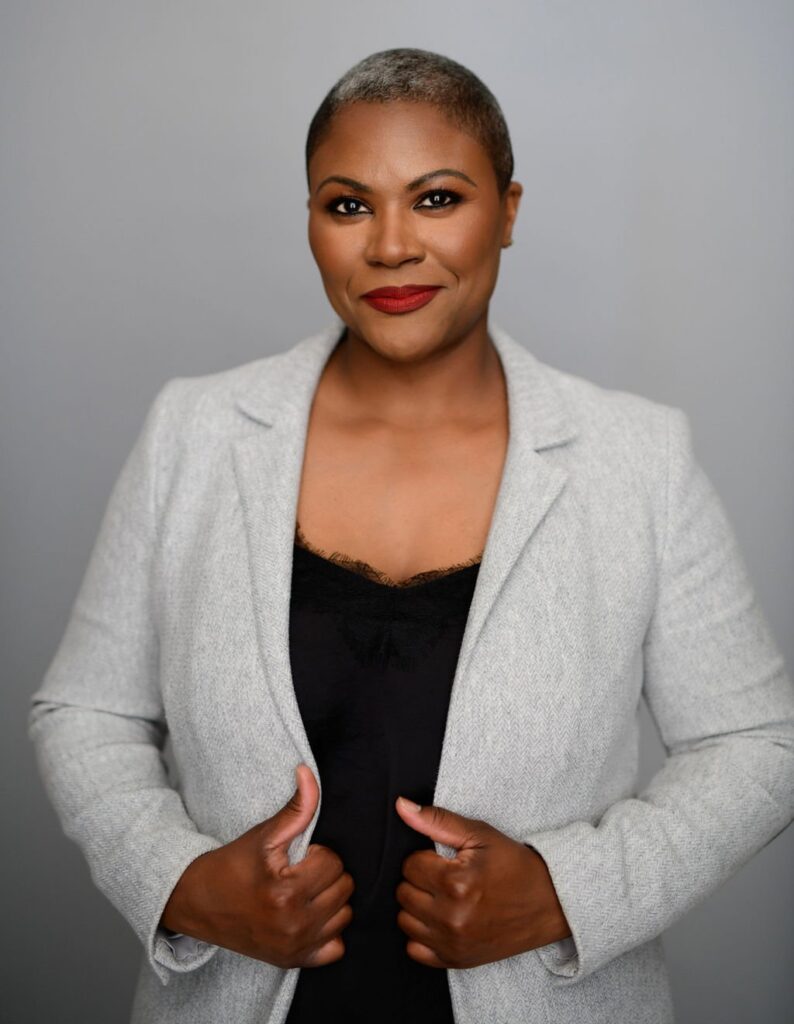
To better understand that mission in the current business climate, I met with Nikki Purvis, the chamber’s president, an engaging, quick-witted leader whose warmth and humor quickly set the tone for a lively and thoughtful conversation.
Fill me in on your childhood, your parents, neighborhoods, and your schools.
I’m a Milwaukee native. I come from a family deeply rooted in faith and love. We lived in the Sherman Park neighborhood. My mom still lives in the family home. But I attended Woodrow Wilson Elementary School in West Allis and was the first Black female to attend that school as part of the Chapter 220 program. A program’s goal was to integrate schools and was implemented by Dr. Howard Fuller when he served as MPS Superintendent.
That experience had to be difficult for you.
It was tough. Even terrifying. I was the only Black girl in the entire school. There were daily aggressions and name calling. But that experience taught me to be resilient. I was the student, who every year, gave the Martin Luther King speech over the intercom. After I finished 6th grade, I was accepted to middle school at Samuel Morris for the Gifted and Talented in the Milwaukee Public Schools system. From 1991 to 1995, I attended Riverside University High School. That was the best experience ever. We were a diverse student body who loved community.
You have an impressive educational background. Take me through your career path and how you got into public service.
I went to Marquette University and received financial help through the Educational Opportunity Program (EOP). My major was Sociology with a minor in Philosophy. I’m very inquisitive. Then, I took a year off to help care for my mom, who was sick. But I went onto get my master’s degree at Cardinal Stritch University in Business Management.
How did you end up as the president of the African American Chamber of Commerce of Wisconsin, the AACCW?
While in college, I worked part time at the Wisconsin Department of Natural Resources. That got me interested in public service. But I did work in the private sector, M&I Bank, Assistant Store Manager for Target and for Kohls. Eventually, I worked in the city of Milwaukee Department of Administration for 13 years. My job focused on small business development. In that role, I got to know many small business owners, and I was a board member of the African American Chamber of Commerce. In 2022, I took the job as president where I am now.
That must have been shortly after the Covid pandemic.
It was pretty rough for small businesses. That experience taught me that there are ways for government and small business to work together in order for people to survive, even in crises.
What exactly is the African American Chamber of Commerce of Wisconsin? What does it do?
We are a nonprofit membership organization. Our mission is to grow Black businesses, but we will support any business who comes through our doors. We make this happen through our advocacy with all levels of government and our programs. We connect our businesses with our internal programs, and if we’re unable to support them, we connect them with external partners. No matter if a business is in the ideation stage, startup, or mature phase, we have ways to assist. This might even mean providing advice on licensing or contracting.
What are your responsibilities as president and CEO?
They are all inclusive. Basically, I manage the staff and handle all the administrative oversight. On occasion, I put on a legal hat. Some days, I even sweep the floors and change the toilet paper. (laughing)
A 2022 study from LendingTree found that Milwaukee ranked eighth for the lowest percentage of Black-owned businesses in major metro regions. Out of 28,668 total businesses in Milwaukee, Black-owned businesses made up roughly 1.8% of that number, lower than the national average. Is that still true in 2026?
We are probably close to those statistics in 2026, particularly because of the economic climate. Unfortunately, some corporations have concern about doing business with Black and Brown businesses.
There is still that stigma even today?
I believe so. There is always the stigma of Black businesses having to prove themselves. I mean the push to be recognized as a legitimate business and even to gain access to resources. For instance, the financial side of things continues to be a challenge.
If I am an aspiring African American entrepreneur who wants to start a business, how do I get access to investment capital, and can the AACCW help me?
We have our Revolving Loan Fund that provides working capital. We received $1 million from the state through the American Rescue Plan Act. Last year, we awarded $900,000 in loans to 18 business at two percent interest.
I guess I was also referring to access to capital through your connections, to a bank or credit union, for instance.
Sure. When our funding cycle is closed, we can direct businesses to those resources in the community. And we are well connected to organizations such as Legacy Redevelopment Corporation, WWBIC and traditional lending institutions. There are also resources businesses can access, like KIVA, for example, which is a crowd funding site that offers 0% interest loans.
I understand you have a co-working hub at the AACCW facility. How does that work?
Our co-working space had been accessible to any member who wants to meet with customers or co-workers. But that is changing. We’ve found the co-working concept is steering toward virtual encounters instead of in-person. The internet and post-Covid have brought on this change.
One of your programs is Rise Milwaukee. What does Rise Milwaukee do, and how does it help prospective business owners?
RISE MKE is our 14-week training program. Once a week, we meet with a cohort of about 14 businesses, some in the ideation stage, some established. We talk about financing with an accountant, human resources, marketing, and how to engage a customer base. RISE MKE is all about professional training. At the end of the 14 weeks of training, we have ‘pitch night’ where participants can each pitch their business to a panel of judges and community members. We had nine cohorts go through the RISE program, and 84% of these businesses are still in operation. This tells us that these businesses are providing a product people want. This program allows us to have the conversation with entrepreneurs to determine if their business should remain a hobby, because all hobbies aren’t meant to be businesses. It requires business acumen.
You facilitate funding through your RISE Opportunity Fund. How does that work? Last year, the Rise Opportunity grant from the state of Wisconsin Department of Administration provided millions of dollars in grants for small African American businesses. What have been the results of the grants?
The RISE Opportunity Fund is another part of the American Plan Rescue Act Funds from the federal government. The state awarded us with $5 million, and we awarded a little over $4 million in grants across the state of Wisconsin, mainly Kenosha, Racine, Madison and Milwaukee. The funds can be used for payroll, rent, equipment, and services reimbursements up to $50,000. That money goes for grants, not loans. We helped over 150 businesses, generally a $50,000 grant for each one, though not every business received $50,000.
I understand the AACCW represents over 200 members, including small businesses, corporate partners, and nonprofits. If I am a businessperson, what benefits would I get for being a member?
You get candid advice from staff. You have access to our workshops. You can market your business through our newsletter and other platforms. Our directory includes Black-owned businesses. For instance, a large corporation may contact us looking for different kinds of vendors such as construction, catering, interior design, daycare and we utilize our directory to connect members with potential clients.
I’ve done stories on Kevin Newell of Royal Capital and Michael Emem of the Emem Group, both highly successful young developers, and I’ve done stories on Natasha Broxton, the Select Auto Parts owner, and on Angela Mallet of HoneyBee Sage. Are there any other recent Black-owned business successes you can think of?
Those individuals you mentioned are connectors. They build relationships with people, which is key to running a good business. And they are positive, which is an important step in leading to success. As for successful Black-owned businesses, there are so many to choose from, but I’ll mention Lean Design Werks, Great Impressions, Next Generation Day Camp owned by Anita Robertson, and Pwr Fwd Media run by Jeff Cannady. There are many more.
