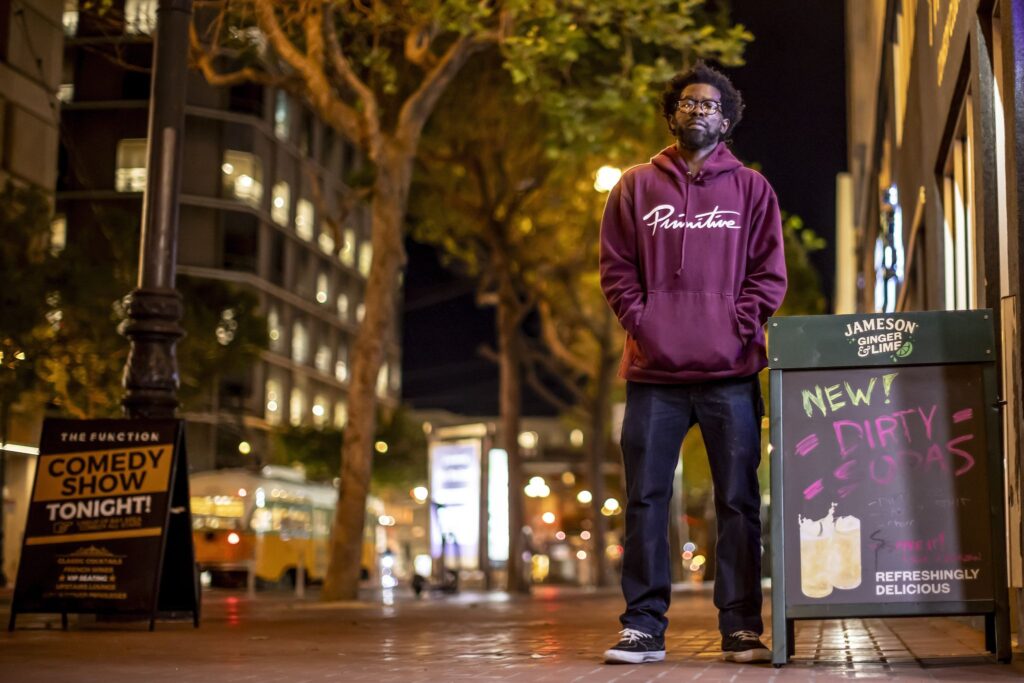
Stroy Moyd tried to open his comedy club at various locales in San Francisco, to no success. Then he looked at the Mid-Market neighborhood. Now he’s among a new wave of entrepreneurs bringing new life to the beleaguered area.Carlos Avila Gonzalez/S.F. ChronicleImad Mourafik and his wife, Fatima Akbali, who are visiting from Morocco, laugh during a show at the Function Comedy Club, one of the new spots that has opened in San Francisco’s Mid-Market area.Carlos Avila Gonzalez/S.F. ChronicleThe main dining area at the Market food hall has brought activity back the first floor of the former Twitter building at Market and 10th streets in San Francisco.Jessica Christian/S.F. ChronicleHoly Stitch owner Julian Prince Dash has been working out of his Mid-Market location for 14 years.Manuel Orbegozo/For the S.F. ChronicleHost Hono Ortiz writes in performers’ names before a comedy show at the Function Comedy Club.Carlos Avila Gonzalez/S.F. ChronicleOf all the places Stroy Moyd imagined opening San Francisco’s first Black-owned comedy club, Mid-Market was last on the list. After two years, more than 80 locations toured and repeated rejections from landlords unwilling to bet on a young Black entrepreneur without deep pockets, it was the only place where he heard “yes.” Article continues below this adThe Function Comedy Club and Cocktail Lounge sits across from the mostly vacant former Twitter headquarters at 10th and Market streets, a stark symbol of the neighborhood’s boom-and-bust cycle that spiked before the pandemic with venture-backed tech and private equity groups taking over buildings that had been home to nonprofits and social services. Now many of those buildings are empty and storefronts boarded up. Nowhere to be found are the sort of buzzy restaurants, bars and boutiques that fuel nightlife and draw crowds to the main drags of neighborhoods like North Beach or the Marina. Hono Ortiz asks the audience to rate comedian Artemii Stephanets’ jokes compared to Gooch, the AI comedian, during a comedy show at the Function Comedy Club.Carlos Avila Gonzalez/S.F. ChronicleMoyd may not have planned to be here, but he is part of a small, determined wave of entrepreneurs betting on Mid-Market at a moment when much of the city’s focus is on reviving other corners of downtown. It’s an early sign of something like an organic rebirth as some in the neighborhood are vying to shift its identity away from a failed tech hub into an arts and theater district. Mid-Market is already home to five major theaters that, in a good year, attract upward of a million people to everything from Broadway musicals to hip-hop concerts. San Francisco Chronicle LogoMake us a Preferred Source to get more of our news when you search.Add Preferred Source“If you look at a thriving arts and culture district, it encompasses the entrepreneur, the denim maker down the street, the restaurateur, the guy who pours his love and soul into his cafe and is a welcoming third space to people,” said Fernando Pujals, executive director of the Mid-Market Business Association and Foundation. “All the bones are here.”Article continues below this adTaro McCarthy, left, likes the skate park at U.N. Plaza on Market Street because it’s not gated, making the experience more freeing and connected to the city.Manuel Orbegozo/For the S.F. ChronicleYears after the start of the pandemic, many of those invested in the neighborhood say conditions are finally improving. Yet the commercial retreat from Mid-Market is still visible on nearly every block. The once-bustling Twitter building is now 96% empty. A 65,000-square-foot Whole Foods has been shuttered for three years after closing abruptly amid safety concerns. The historic Hotel Whitcomb remains boarded up after sustaining tens of millions of dollars in damage during its use as a pandemic-era shelter for the homeless. Office vacancy in the surrounding district hovers around 45%, with retail not far behind. It was so bad that during the depths of the pandemic, some in the local real estate community wouldn’t bring clients to the area. A gaping hole occupies the northeast corner of Market and Van Ness, which a developer excavated for a 47-story mixed-use project that was put on hold three years ago. Mid-Market has been here before. After the Great Recession left the corridor lined with empty storefronts, city leaders offered tax breaks to lure tech firms in a bid to bolster its economic base. The Financial District’s offices had to reach near capacity before the city’s attention shifted to Mid-Market, downtown’s main artery connecting City Hall to the Embarcadero. Even then, it took a relentless focus from City Hall to attract investment to the neighborhood.For a time, it worked: Companies moved in, housing was built, and the neighborhood flickered to life briefly with the promise of a dense, around-the-clock downtown corridor. There were bike shops and restaurants — one business sold handcrafted toffee and another offered flights of chai. But even before the pandemic emptied offices, that momentum had begun to slip. Today, with many of those same firms gone in search of cleaner, safer surroundings or contracting their operations in the era of remote work, Mid-Market has largely returned to where it started before the 2009 tax break.Article continues below this adAnd yet, a different kind of risk-taker is beginning to fill the void: Entrepreneurs like Moyd, often with fewer resources and less institutional backing, are moving into the very spaces others abandoned — drawn to the possibility of building something new, and hopeful that others will follow.Shervin Shoustary, the landlord of a seven-floor building at 965 Market St., has seen many tech companies come and go from the neighborhood since his family took over the building in 1995.Manuel Orbegozo/For the S.F. Chronicle“Ideally, this strip would be full of shops, food and bars,” Moyd said. “But that takes a lot of effort, energy and consistency.” He pointed to the millions of dollars in grants and funding that has been doled out to lure businesses to the Financial District and other parts of downtown. Earlier this month, a new group formed by corporate and philanthropic leaders to back Mayor Daniel Lurie’s downtown revitalization strategy unveiled a $25 million business revitalization fund providing grants and loans to small businesses activating a commercial corridor north of Mid-Market.“They need to move that over here,” Moyd said. “In order for this neighborhood to do well, we need the city of San Francisco behind us.” Article continues below this adDiana Ponce De Leon, of the Office of Economic and Workforce Development, said the city is actively recruiting businesses to the Mid-Market area, helped a nonprofit buy a building and is providing grants to support businesses moving into vacant storefronts. An entertainment zone created between Fifth and Sixth streets was activated with block parties last year.“We are leveraging everything we have in the area,” she said. “I feel the energy is there. People are interested. It feels cleaner. We still need to bring back the foot traffic.”With or without the city’s help, businesses are starting find their way back into the neighborhood. Walk by the southwest corner of Seventh and Mission into the night and you might hear music drifting from the Roar Shack, an arts space run by the Living Earth Show, a nonprofit that creates and performs experimental chamber music. It’s the first new independent music venue to enter the neighborhood in years.The Roar Shack fills the space vacated by nightclub Mr. Smith’s, which closed in 2019. Building owner Max Young, who also operated Mr. Smith’s, said the block had become so overrun with drug dealers and loiterers that he felt it was unsafe for patrons and staff. The two office suites upstairs, which had been occupied by tech companies, also emptied during the pandemic.Now the whole building is full again, with two new startups taking space on the upper floors. The streets are much cleaner and the drug-dealing less conspicuous.Article continues below this ad“The Mid-Market story is kind of rewriting itself right now,” Young said. “It’s not perfect. It’s not Disneyland. But it’s a huge difference from where we were.” People eat in the main dining area at the Market food hall located in the first floor of the former Twitter building.Jessica Christian/S.F. ChronicleA few blocks to the west, the massive food hall on the ground floor of the former Twitter building that was nearly empty a year ago is filling up with a new generation of vendors selling empanadas, gnocchi, boba, caprese sandwiches and açaí bowls.“A year ago I was like, ‘What am I even doing here?’” said Joy MacDonald, who manages the market. “Now it’s cleaner outside, there are more people walking by. We get a lot of people coming in and saying, ‘I haven’t been here in years.’”Ground floor activation was often an afterthought for both new residential and office towers, but for Mid-Market’s recovery it will be key, said Benjamin Kochalski, a partner with TMG Partners, which has a long history of investing and developing in the neighborhood. A neighborhood’s recovery “doesn’t start on the 30th floor of a building,” he said, adding that Mid-Market’s offices are unlikely to benefit from increased office tenant interest until higher-demand space in the Financial District is absorbed. “It’s not ‘main and main’ as it relates to office space,” said Chris Pearson, senior vice president of development for Hudson Pacific Properties, describing the neighborhood’s competitive position for attracting the latest wave of tech startups. Hudson Pacific recently filed plans to convert one of its two Mid-Market office buildings into housing.Organizations like the Mid-Market Foundation are stepping in to act as the intermediaries between the neighborhood’s landlords and small-business tenants. Pujals, the foundation’s director, said the organization helped subsidize the Roar Shack’s first year of rent. The group keeps a database of all of the neighborhood’s ground floor commercial vacancies, and a list of landlords willing to provide concessions or support. Between Fifth and Seventh streets, the foundation has identified seven turnkey spaces ready for occupancy. There has been “incremental” progress, Pujals said, along with setbacks. The Red Tail Wine Bar, which the foundation also supported in opening at 992 Market St., closed after just a year of operation in Mid-Market.One of the challenges to revitalizing the neighborhood’s ground floor ecosystem is its large number of sizable cold-shell spaces, which require significant up-front capital to activate.Pujals believes that with focused investment, both the arts and tech can flourish side by side in the neighborhood despite the fact that museums and arts venues across downtown have been struggling. “If we were to lean in and center investing and fostering this creative economy in the neighborhood, I think that you would see a secondary wave of office lease up as the broader downtown begins to fill up as well,” Pujals said.That thesis is being tested in real time on the northern edge of Mid-Market, where nonprofit Community Arts Stabilization Trust purchased the historic Warfield Theatre at 988 Market St. for $7.3 million last year, about half of what the building sold for in 2015. With public radio station KALW as the anchor tenant, CAST has been working to transform the nine-story building into “Warfield Commons,” a hub for arts, culture and media nonprofits. Today, the building is 90% leased.Holy Stitch owner Julian Prince Dash has been working out of his Mid-Market location for 14 years. He believes the businesses that find success in the neighborhood are those that serve as “assets to the community.”Manuel Orbegozo/For the S.F. ChronicleA block away, landlord Shervin Shoustary recently landed a robotics startup as a new tenant at 965 Mission St. Shoustary said tours with AI and robotics companies are increasingly resulting in signed leases at his building, and credited the city’s focus on public safety and cleanliness in the area. “We are seeing great results,” he said. Julian Dash, owner of the Holy Stitch sewing factory at 1059 Market, has seen this cycle before: First comes the blight and vacancy, then the priced-out creatives that leave their “thumbprints” on disinvested spaces, driving property values up, he said. “The suits usually follow.”A 15-year fixture on Market Street, Dash has watched waves of attention crest and recede on Mid-Market, where he has occupied multiple storefronts. Dash described himself as one of Mid-Market’s “longest-standing activators.” Previous efforts to breathe life into Mid-Market failed because they resulted in services and businesses that proved inaccessible to the very communities that are essential to its vitality, according to Dash. Catalina Robles, a fashion designer from Chile who runs her own clothing business and rents a space at Holy Stitch, works on a wedding dress at the shop.Manuel Orbegozo/For the S.F. Chronicle“My base rent is like $6,000 per month. Next door, the same ground-level space is going for $20,000,” he said, referring to a property that once served as a former adult entertainment venue before it was replaced with a modern eight-story new development — or as Dash put it, a “fancy, stereotypical condo building.” The rent sought for that building’s languishing, 7,100-square-foot ground floor storefront is still lower than the city’s average for retail spaces, which according to Costar, is about $40.65 per square foot. But, for Dash, the stubborn vacancy next door is “indicative” of Mid-Market’s biggest problem: “Maybe some things are being forced into a district that wasn’t built for that.” Dash believes the businesses that find success in Mid-Market are those that serve as “assets to the community.”“I fix people’s clothes and give young people a place to learn, and my business is growing,” he said.With many questions still surrounding tech’s office needs in post-pandemic San Francisco, some of Mid-Market’s institutional landlords appear to have shifted strategies. Hudson Pacific, which once rented its 22-story office tower at 1455 Market St. to Uber, is now banking on a different type of office tenant to fill the void: public agencies. The landlord signed a long-term lease with the city to backfill vacancy in the building — the deal provides the city with the option to purchase it next year. “It’s a 1.1-million-square-foot building. If that were to just sit there empty in perpetuity, it’s going to drag the rest of the market,” Pearson, of Hudson Pacific, said. “To have actual tenants in the building now with city employees occupying it, is going to help lift all ships in that area.”The deal with Hudson Pacific ushered in a potentially broader shift that some city officials are now actively exploring. Mid-Market Supervisor Matt Dorsey recently nixed a deal that would have allowed the San Francisco Employee Retirement System, the city’s pension fund, to exit its longtime offices in the neighborhood and relocate to the Financial District.People enter the Market food hall in San Francisco.Jessica Christian/S.F. Chronicle“I have been saying for many years that San Francisco’s most underutilized resource is Market Street,” said Dorsey, while addressing a roomful of early-stage founders, techies and researchers inside of the newly launched Frontier Tower at Sixth and Market streets earlier this month. The 16-story tower, once valued at $62 million and home to flexible space provider WeWork, was languishing with vacancy just a few years ago, leading to its sale at a 90% discount in 2024. It has since been reborn as an underground tech coworking hub with more than 700 members — proof that Mid-Market still appeals to the startup world. Dorsey said that he believes technology will continue to play a big role in Mid-Market, alongside the city. He plans to call a hearing to determine what the city “can do with its assets to put skin in the game on Market Street.”“I want to make sure that Market Street is a showplace from the Castro to the Ferry building, and people will wonder why it took this long,” Dorsey said.Market Street remains an essential corridor for San Francisco, connecting the Embarcadero to City Hall.Jessica Christian/S.F. ChronicleDavid Seward, chief financial officer of UC Law San Francisco, agreed with Dorsey that “the city should take some responsibility for mitigating some of the damage.” The law school, which has invested $500 million in building an academic village just off Market Street in the Tenderloin, was part of a 2020 lawsuit over the dangerous conditions on the sidewalks and in the doorways, calling it a public health menace.“The emptying of the Twitter building was negative. Whole Foods’ decision to pull up stakes was negative. And some of that was driven by city policies that were adverse to activation of the community,” he said. “I believe Mid-Market is the key to the Tenderloin’s revitalization and for Union Square as well.”Mid-Market, to others, is a proving ground. Tech may have a reputation for being fickle about the neighborhood, but the new generation of future-minded optimists building the city’s latest innovation hub at one of its most challenged intersections is betting on creating something more enduring. “One of the great things about San Francisco is that it’s a city that constantly reinvents itself, and Mid-Market in particular has always been the pivot point in the city — it’s the center point,” said biotech founder Elliot Roth, a member of Frontier Tower. “How do you enable positive change in the city? You don’t want to do something that’s just a brief, momentary interjection. You want something that’s sustained and builds for the long term.”
Source link