





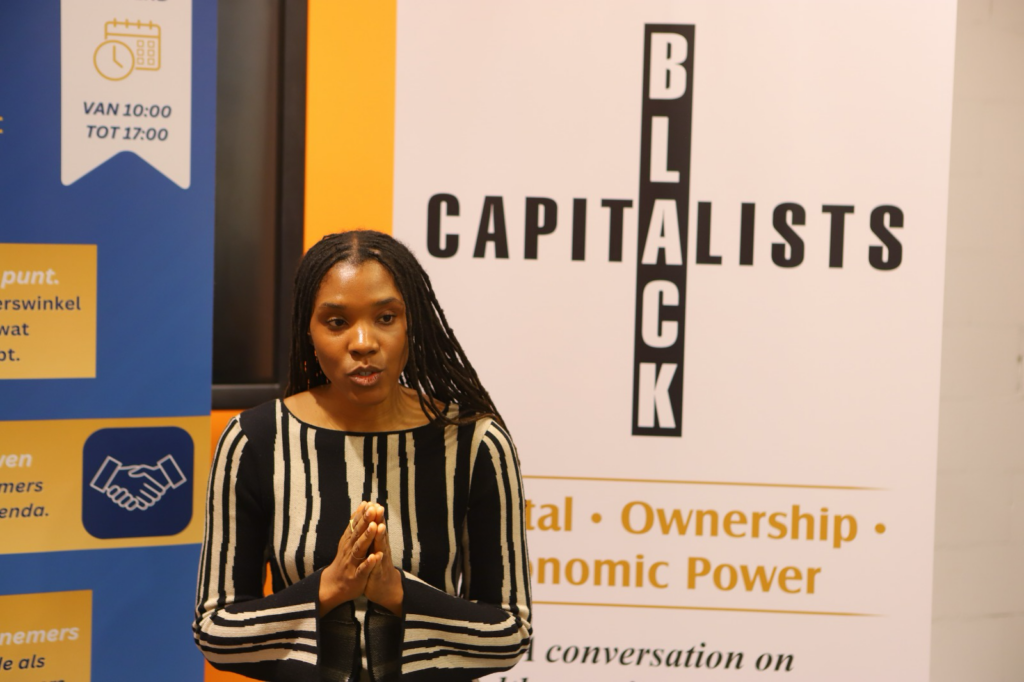
Across Amsterdam, Brussels, Paris, and London, a new wave of dialogue on economic empowerment, ownership, and long-term wealth creation is taking shape.
The Black Capitalists book tour is bringing together leaders, entrepreneurs, policymakers, and members of the African diaspora in a series of curated gatherings that move beyond conversation into coordination.
The European tour was initiated and organised by Nii Dsane, CEO of Q-Advise, a global software advisory company headquartered in the Netherlands.
His vision has been instrumental in convening high-level, cross-sector dialogue across multiple cities and positioning the tour as more than an event series, but as a movement.
At the centre of the tour is Dr Rachel Laryea — a Wall Street scholar, financial anthropologist, global speaker, entrepreneur and author of Black Capitalists: A Blueprint for What Is Possible. Her work challenges how Black communities engage with capital, ownership, and economic systems globally, not from the margins, but from a position of agency.
About the BookBlack Capitalists: A Blueprint for What Is Possible offers a grounded and provocative examination of how Black visionaries, from Wall Street to Lagos and beyond, are reimagining capitalism to serve broader societal outcomes. Combining personal narrative, historical analysis, and on-the-ground reporting, Dr Laryea interrogates who benefits from capitalism and under what conditions.
The book reframes participation in economic systems not as passive inclusion, but as strategic engagement with responsibility. As Vanessa Williams describes it, it is “a must-read.”
The tour opened in Amsterdam with a focused session for women entrepreneurs, organised in collaboration with Zwarte Vrouwen voor Technologie and Ondernemerswinkel Amsterdam. The room was defined by ambition, but more importantly, by clarity.
Speakers, including Siomara de Getrouwe-Spalburg and Marianne Dorder-Servet, emphasised a necessary shift: entrepreneurship must move beyond survival toward structured, scalable growth. Conversations centred on access to capital, business design, and building systems that sustain long-term value.
That tone carried over to the Black Capitalists Dinner and Discussion Forum, where diplomats, corporate leaders, and policymakers, including Anouschka Biekman, engaged in direct, at times uncomfortable, conversations about capitalism and access.
Moderated by Nii Nmai Dsane, the discussion moved beyond theory. It focused on what it actually takes to participate in, and ultimately shape, economic systems.
“The tools of capitalism are race-neutral,” Dr Laryea noted, “but access to those tools has never been. The work we must do is understand the system well enough to navigate and reshape it to produce outcomes in service of our communities.”
Brussels: From Theory to Structure
In Brussels, the conversation evolved. With participation from members of the Ghanaian diplomatic community, alongside entrepreneurs and diaspora professionals, the discussion sharpened.
Different interpretations of capitalism emerged, ranging from free-market ideals to structural critiques of institutional barriers. But rather than remaining philosophical, the dialogue turned practical. How do diaspora communities collaborate across borders? What structures enable durable wealth creation? How does capital circulate intentionally within communities?
The conclusion was clear. Participation is not enough. Without positioning and ownership, participation has a limited impact.
Paris: Recognition and Expansion
In Paris, the tour gained formal recognition. Dr Rachel Laryea’s work was acknowledged by the Ghanaian Community in France Council and the Global Diaspora Council, under the leadership of Osei-Mensah Michael.
Here, the conversation expanded outward. Discussions addressed systemic barriers, as well as the growing influence of diaspora networks in shaping economic futures beyond national boundaries.
“It is not about one individual,” Dr Laryea said. “This is a collective effort to rethink how we build, own, and sustain wealth.”
London: Energy and Application
The European leg concluded in London with a reception and forum hosted by The 10 Talents Global at the London Latvian Centre.
The atmosphere was more informal, but the substance remained. Ahead of Dr. Laryea’s keynote, Dr Flora Chigwedere and Dr Ashiedu Joel grounded the discussion in lived experience, sharing practical insights from their respective journeys.
The panel that followed, featuring both speakers alongside Nii Nmai Dsane, focused on leadership, economic inclusion, and execution. The exchange was direct, at times light, but consistently grounded in reality.
Dsane emphasised a core principle of the tour: ownership starts locally. It is about investing in the environments where people live, work, and build their futures.
Across all four cities, a consistent pattern emerged. These were not symbolic gatherings, but deliberate convenings designed to connect sectors that rarely intersect: policy, finance, entrepreneurship, and community leadership.
The underlying thesis is straightforward. Wealth is built. Through structure. Through access. Through discipline. And ultimately, through ownership.
What distinguishes the Black Capitalists tour is its shift from dialogue to coordination. Participants are not only exchanging ideas but actively exploring collaboration across cities and countries, reinforcing the role of the diaspora as a global economic force.
With future engagements planned across Africa and continued momentum within the diaspora, the initiative is positioning itself as a long-term platform for economic development.
As Dr Rachel Naa-Du Laryea puts it, “To me, Black Capitalists is not just a book. It is a movement. A movement to build, not just individually, but collectively. Across cities, countries, the diaspora, and Africa.”Read More
Source link
