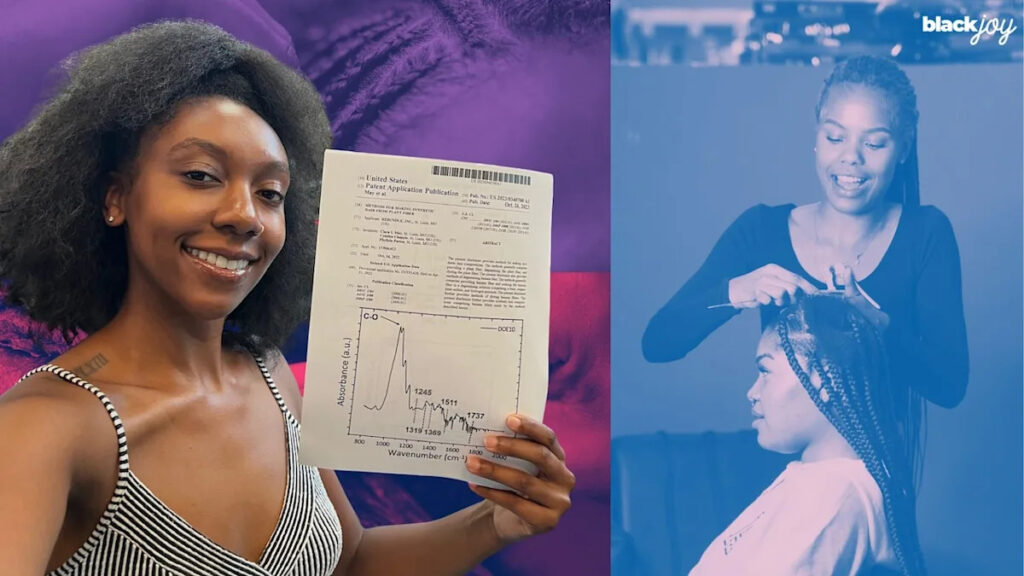
Want more good news in your inbox? Sign up for the Black Joy newsletter to bring more joy into your life. New issues every Monday, Wednesday and Friday.To Ciara Imani May, Black people deserve to live in a world where beauty doesn’t equal pain.May, the daughter of a hairdresser in Kansas City, Mo., has spent the past several years scaling and improving the nation’s first plant-based braiding hair brand Rebundle. In June, May learned the United States Patent and Trademark Office approved Rebundle’s patent for its hair extension line called braidbetter.“The patent protects the core innovation behind braidbetter, giving it its unique texture, durability, and scalp comfort. For our community, it’s further proof that this product is protected, scalable, and here to stay,” May said on Instagram. “We’re laying the groundwork for the future of hair extensions, shifting the industry from a lack of innovation to a focus on safety and sustainability.”May dedicated herself to creating a hair alternative that’s healthy for the human body and the environment after she noticed how synthetic braiding hair left her scalp feeling itchy and inflamed. The synthetic hair commonly sold in beauty supply stores can only be used once and isn’t recyclable. Rebundle’s braidbetter extensions are made with natural, biodegradable materials that don’t disturb the scalp’s microbiome and can be reused up to three times.Inventing the technology behind this product has been an inspiring story – one that May is excited to share through her company’s documentary “Reclaimed.” May and her team are currently working out the details to screen the film in Atlanta, Chicago, Los Angeles, New York and other cities where Rebundle has a large fanbase.“We realized there was much more to the story than just where we sourced the fibers or who we work with, but really thinking about how all the touch points that the product has along the value chain,” May said. “We weave together these elements and different experiences: the customers, braiders, salon owners and beauty supply stores. They all have a different viewpoint on what it means for us to reclaim this industry that has been fueled by us, but not led by us – not dominated by us. So we just wanted to put that all into one compelling story and make something that felt relevant to who we all are as part of the beauty and hair industry.”Rebundle’s patent approval comes after Consumer Reports released its study detecting cancer-causing chemicals in braiding hair. Researchers lab-tested 10 of the most popular synthetic hair brands, including Sassy Collection, Shake-N-Go and Magic Fingers, for various toxic products. All of the brands tested positive for carcinogens and Volatile Organic Compounds, or VOCs, which are chemicals that evaporate at room temperature and have become known for causing different health issues. Nine of the brands also contained lead.Consumer Reports’ study adds to the growing list of research and lawsuits revealing the toxicity within the Black haircare industry. Thousands of Black women went to federal court last year to sue parent companies of chemical hair relaxer makers, which include household names like L’Oreal. These lawsuit filings were triggered by a 2022 National Institute of Health study showing an increased risk of uterine cancer in Black women who regularly use relaxers.May says these reports reveal what has always been an open secret in the Black community.“When Consumer Reports released that study earlier this year, it was validating for us because it’s what we had known all along, but we needed that market validation to confirm our suspicions and to substantiate some of that with data we knew anecdotally,” May said. “But you know, it’s not our responsibility to produce a study on what’s in other people’s products. That’s something scientists, researchers and consumer safety advocates should be invested in, and we’re really glad to see there was finally some outside perspective on this product that is very widely used in Black community.”Rebundle has been developing a solution to this issue since 2019. While most synthetic braiding hair is made of plastic, Rebundle’s hair is made with banana fibers sourced from Africa. May originally started forging relationships with suppliers across the Atlantic through different communication platforms, like WhatsApp. In 2021, May made the decision to visit Uganda with the intent to strengthen connections and build a better product. May has been visiting the continent once a year ever since.“Being there in person is always very impactful,” May said. “While we were able to get our first two suppliers before I eventually made the trip, the relationship we needed to have established was one that could really only be forged by spending time together and getting to know one another. Those relationships have continued to serve us today, and given us the playbook and the roadmap needed to take the business to the next level.”Getting Rebundle’s braidbetter technology patented was always part of May’s plan. In early 2021, she and her team worked with intellectual property lawyers who’ve helped Rebundle submit a strong application to the United States Patent and Trademark Office. Free assistance from Saint Louis University helped May file her business as a micro entity, reducing the amount of fees Rebundle had to pay. The patent and trademark office has a program providing pro bono services to under-resourced inventors and entrepreneurs. May said having good lawyers on her side was the key to her success in getting her patent approved, which is why she advises business owners to check with their closest university for free legal aid.“I wouldn’t really describe this process as challenging. It’s just something that takes a long time,” May said. “We were able to take advantage of a program that allowed us to apply for the patent as a micro entity, meaning we only had to pay for the filing itself. We didn’t have to pay for the actual work the lawyers did, which was a great resource for us as an early-stage business.”Along with making hair, gel and mousse that’s good for the scalp, Rebundle is an environmentally-friendly, community-centered brand. The braidbetter hair is compostable. Rebundle recycled almost 1,000 pounds of synthetic braiding hair before pausing that program to search for a more collaborative recycling company to work with, May said.Customers can find local braiders in their area who use braidbetter in their services by searching Rebundle’s directory of almost 400 hairstylists in the United States and United Kingdom. May plans to increase braidbetter’s accessibility by selling the product in hair stores and growing and deepening the relationships made through the company’s network of hairdressers.The journey of scaling a haircare brand while inventing a new product is long and tedious. But May has learned to write down her small wins to honor a legacy that will leave the community, as well as herself, more empowered.“I’ve learned that being a Black woman entrepreneur in haircare means being both a builder and an advocate,” May said. “I often feel like an activist in the way I approach my work. I think being a social entrepreneur adds a layer of responsibility that I’ve learned to embrace.”
Source link