





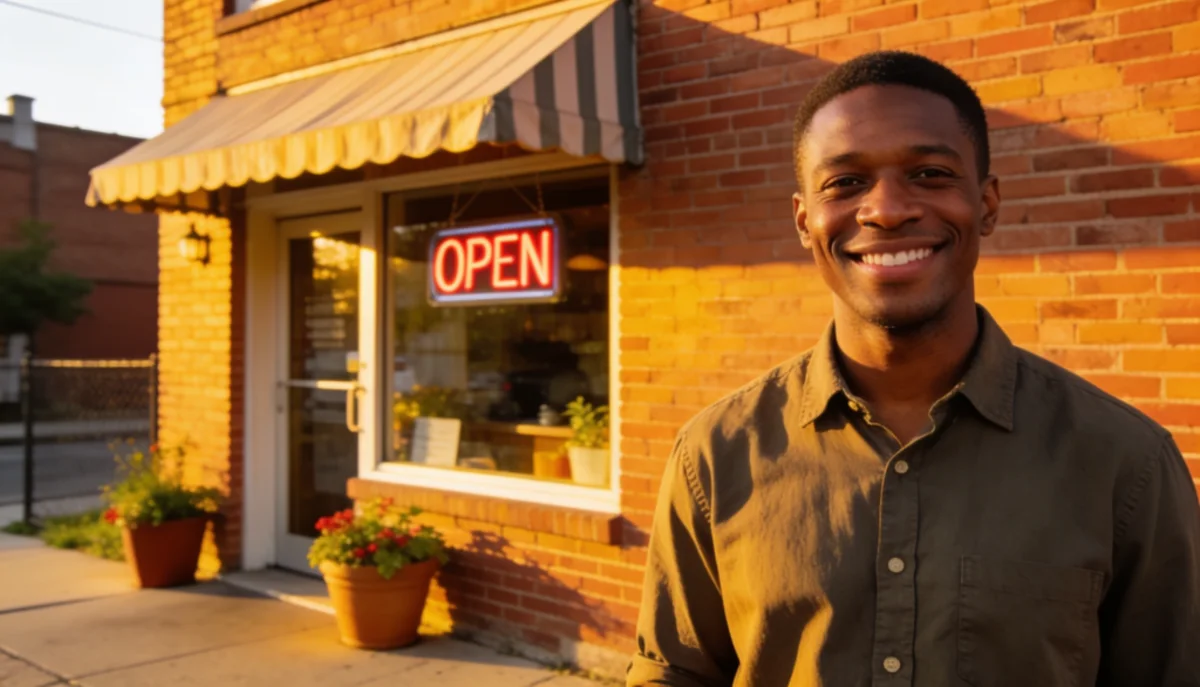
Written by Marcus Randolph
I want to encourage everyone to celebrate and support Black businesses beyond Black Business Month, but I also want to change the narrative.
Yes, shopping Black matters. But if we want Black businesses to open, expand, employ people, own property, and create generational wealth, celebration cannot be the end of the conversation. We have to talk about capital. The U.S. Chamber of Commerce found that “Black entrepreneurs are nearly three times more likely than White entrepreneurs to have business growth and profitability negatively impacted by a lack of financial capital.”
Earlier in my career in banking and investments, I closed over one billion dollars in financing. Through that experience, and what I see working with businesses in Newark, New Jersey, now as president and CEO of Invest Newark, I understand just how important proper funding is. When it comes to a business’s success, it always comes back to the need for capital.
The City of Newark, under the leadership of Mayor Ras J. Baraka, has taken action to address this issue—and the results are real.
In 2024, under Mayor Ras J. Baraka’s leadership, the City of Newark and Invest Newark launched a unique program to help businesses and not-for-profit organizations locate to Newark’s burgeoning downtown core. Under this program, the City and Invest Newark made low- to no-cost financial assistance available to businesses looking to be located in the focus area. Business operators were eligible for up to $650,000 in support, depending on the storefront’s square footage. Funds could be used for exterior and interior improvements to the vacant space or to purchase furniture, fixtures, and equipment. This program was developed in collaboration with Bloomberg Associates, the pro bono consulting arm of Bloomberg Philanthropies, which works with cities and mayors around the world.
Invest Newark also runs a wide array of loan programs offering low-cost capital to business owners for inventory, equipment, construction, fit-out, and even predevelopment.
These grants and loans lead to real stories like Abdul Roberson, a Newark native who brought his deli Abby’s back to his hometown from a neighboring city. The special part — he bought and renovated a dilapidated mixed-use building with a loan from Invest Newark, and now he operates his restaurant on the first floor and receives rental income from apartments. Now that builds wealth.
Or Justin Williams, a comedian who saw a gap in Newark’s nightlife and gathered friends and fans to become investors to open Newark Culture Club. A Black-owned small performance venue and cocktail bar, he secured institutional bank financing, a retail reactivation grant, and participated in Audible’s unique Business Attraction Program.
Or Brittany and Gladys Payton, a mother-daughter duo who saw the need for a high-end spa experience in Newark – and filled it with Aulo Spa. They also needed capital and found it with a bank that believed in their vision, and our retail reactivation grant helped them get their gorgeous spa fitted out–right across from NJPAC.
Capital is not just about opening the door; it’s also about keeping that door open. Capital is staying power. I like to say that wealth creation is not a one-time event. When a business gets access to capital, it does not equate to becoming an overnight success. Creating a successful business isn’t the 100-meter dash; it’s the long-distance marathon, maybe even an ultramarathon.
Having capital means having a runway to success: the ability to withstand change and volatility in an uncertain market, hire, expand, buy property, and make decisions with a longer-term frame of reference instead of just thinking in the short term.
When someone opens a business now, it has the ability to grow and scale, meaning the business owner is setting themselves up for future success.
It is about creating an environment where businesses can survive and scale, with the potential to create opportunities and options for their children and even grandchildren.
At its core, entrepreneurship inherently involves risk. But for Black entrepreneurs, that risk is twofold because they are too often expected to demonstrate near-perfect performance to remain worthy of investment.
This is especially true when issues arise. There’s an extra weight that some of us carry as Black entrepreneurs, knowing, “Man, I’ve got to make this work.” Equal access to capital is not the great equalizer if Black borrowers have less room to navigate the ordinary and inherent obstacles native to entrepreneurship.
I am excited that Black Business Month gives us a reason to celebrate the many Black entrepreneurs who are bringing incredible goods, services, and resources to our communities. But real support is what happens before, during, and after August. It comes down to whether those businesses have the capital to survive, the room to recover from setbacks, the opportunity to scale, and the chance to build something their children and grandchildren can inherit.
That said, I want to issue my call to action: Increase capital to Black-owned businesses all year long.
Marcus Randolph is President & CEO of Invest Newark, Newark’s Economic Development Corporation. Before leading its equitable-growth work, he worked in banking and community development finance and has closed more than $1 billion in financing.
