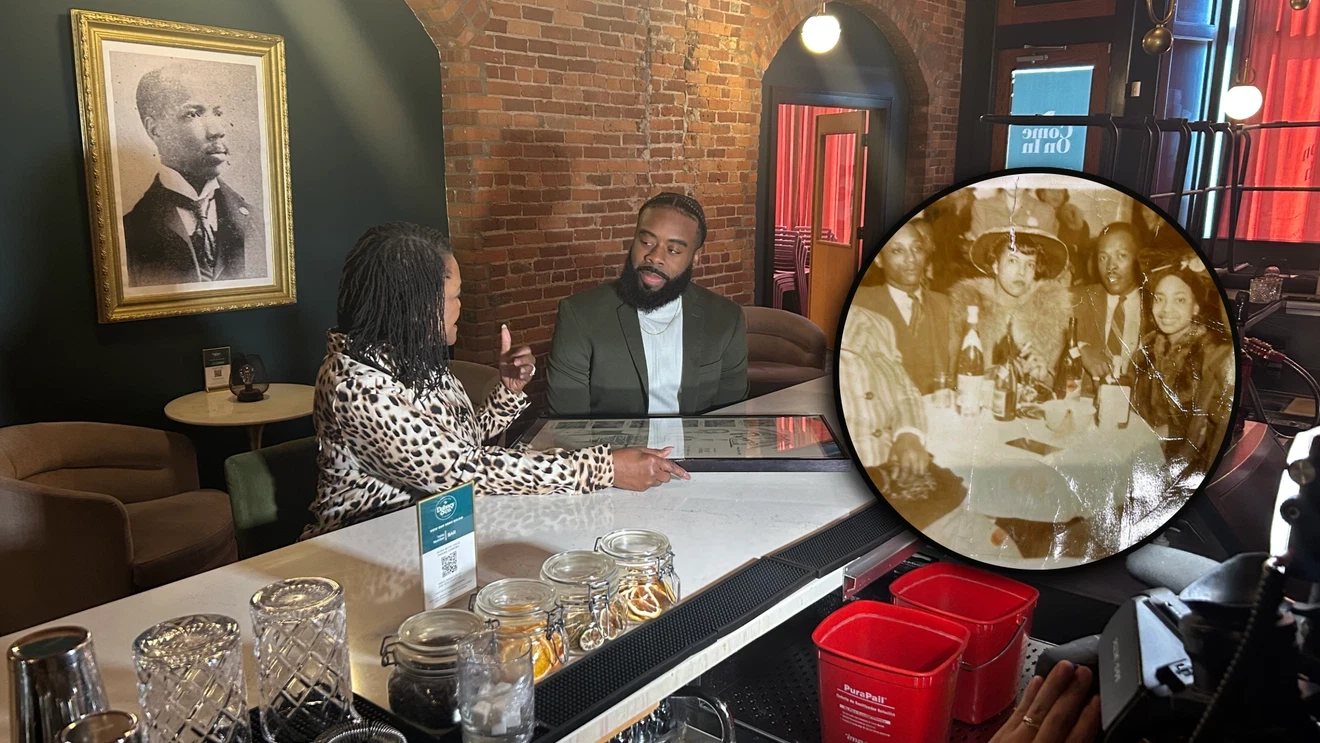
KALAMAZOO, Mich. — Long before craft cocktails and live blues filled downtown Kalamazoo, Black entrepreneurs were carving out spaces of joy, safety and unity in a city like many throughout the U.S. that was shaped by segregation and racial barriers.Since the 1940s, Kalamazoo has been home to just three Black-owned bars. Each arriving in a different era, each facing its own version of the same struggle, how to build community in a place where opportunity was never evenly poured.Today, Dabney & Co., a Southern contemporary cocktail bar that opened in 2022, stands as the most recent chapter in that history. Its existence is inseparable from the legacy of places like Mr. Presidents and The Pacific Club, a multicultural bar founded in 1946 by Council Hawes Jr. He was a Black Marine veteran who believed unity could be practiced, not just preached.The founder and owner of Dabney & Co., Daniel May (Dabney & Co./WWMT) Together, the stories reveal how racism and segregation shaped the past and how that past paved the way for the present.Dabney & Co. owner Daniel May says he never takes lightly what it means to be only the third Black-owned bar and restaurant in Kalamazoo’s recorded history.“It’s an incredible honor to even have made it this far,” May said. “We’re standing on the shoulders of those who came before us.”May, originally from Cleveland, Ohio, came to Kalamazoo to attend Western Michigan University and never left. What he noticed was something missing, not just in food or nightlife, but in cultural representation.“I recognized that we were lacking that real heart of soul, blues, Black cultural music and a space that truly celebrated it,” he said.That vision is reflected everywhere inside Dabney & Co., from the live blues and jazz performances every Friday night to the walls filled with images of legendary Black artists. The intention, May says, is simple but urgent: Black artists should never be forgotten.“Black history is American history,” he said. “And we make sure people feel that the moment they walk through our doors.”Even the menu carries that legacy. May creates every recipe himself, many inspired by his grandmother Claudia, blending family tradition with Southern contemporary cuisine. Dishes like collard green dip, black-eyed pea hummus and peach cobbler cornbread are rooted in memory as much as flavor.The founder of The Pacific Club, Council Hawes Jr. (Doreen Gardner/WWMT)The bar’s name itself is history. Dabney & Co. honors John Dabney, the first renowned African American bartender, who famously used the profits from his mint julep to purchase his freedom and that of his wife.“It’s liberation through spirits,” May said. “And paying homage to the Black mixologists who paved the way.”Decades before Dabney & Co., The Pacific Club was already modeling what inclusive community could look like even in the face of open discrimination.Founded in 1946, the club was owned and operated by Council Hawes Jr., a U.S. Marine who served in the Pacific during World War II. The name honored his service but the mission honored humanity.Customers at The Pacific Club{ }(Doreen Gardner/WWMT)“He wanted a place where people of all races, all nationalities could come together and respect one another,” said Mrs. Doreen Gardner, Hawes’ niece. “That was his real mission.”She’s also the current own of Papa’s Brittle, a decades-old family recipe that can now be found throughout local grocery stores in Kalamazoo.Now at a time when segregation was the norm, The Pacific Club was intentionally multicultural. Patrons were required to sign a creed committing to respect and unity. Membership cost $10 to $20, which was a significant price at the time and the rules were non-negotiable.But, simply opening the doors came at a steep price.Gardner says her uncle was forced to pay more than $40,000 to obtain a liquor license. It was an extraordinary amount in the 1940s, an amount Gardner believes her uncle was quoted for because he was Black.“He applied first, but he was the last one to get it,” she said. “Others were approved before him. He had to take legal action because he was discriminated against.”Despite those barriers, The Pacific Club thrived for more than three decades, operating until 1979. Known for its food, entertainment and atmosphere, it welcomed legendary performers including B.B. King, Muddy Waters, and Junior Walker and the All Stars, names that now echo again through Dabney & Co.’s walls.The Pacific Club menu (Doreen Gardner/WWMT)Gardner sees unmistakable parallels between her uncle’s vision and what Dabney & Co. has built today.“This is a multicultural place where people can come in, feel good, enjoy life and just be human together,” she said. “That was his dream.”For May, that connection is both grounding and motivating.“I’m only here because of the ancestors that came before me,” he said. “And it’s my responsibility to help break down doors for whoever comes next.”While challenges persist, including threats and safety concerns since opening, May says leading with pride and love remains the answer.“What keeps us going is joy,” he said. “Seeing people sing their favorite songs, celebrate milestones, and feel at home.”Customers at The Pacific Club (Doreen Gardner/WWMT)Gardner believes the story matters beyond February.“Black history isn’t one month,” she said. “It’s 12 months a year. These stories need to be shared so our children know what it took to pave the way.”In a city where only three Black-owned bars have existed in nearly 80 years, Dabney & Co. stands as proof that history doesn’t disappear, it evolves. Specifically in Kalamazoo, it’s still being written.
Source link