





The problem with all the hullabaloo over the country’s semiquincentennial of independence is that not everyone in Virginia has had 250 years of freedom.
“A Freedom Compromised: 250 Years of Black Life in Virginia,” the new exhibition at the Black History Museum and Cultural Center of Virginia (BHMVA), addresses the complex, enduring, and often contested meanings of freedom for Black Virginians.
The exhibit invites visitors to consider how Black communities in Virginia have lived, labored, resisted, organized, created and shaped democracy while navigating the broken promises of liberty and justice that were denied them since the country’s founding. In the words of Frederick Douglass, “What to the slave is the Fourth of July?”
By 1860, Richmond was a major center of slave trading and fully a third of Virginia’s population was enslaved. A copy of Thomas Jefferson’s newspaper ad seeking the return of one of his enslaved workers, a man called Sandy, characterizes him as “inclining to corpulence, overly addicted to drink, swears much … and in his behavior is artful and knavish,” and yet Jefferson was willing to pay handsomely for his return.
In the 1870s after the Civil War, Virginia developed a system of incarceration that extended racial control with the Jim Crow era, often described as “slavery by another name.” It was the era of chain gangs and convict leasing using the Black men who were disproportionately targeted through vagrancy laws and other minor offenses. Freedom? Not so much.
Black History Museum and Cultural Center of Virginia is located at 122 W. Leigh St. Photo by Scott Elmquist
But the resiliency, entrepreneurship and community building of Virginia’s Black population is also on full display with a focus on Black financial institutions. Because Black citizens were often denied service by mainstream banks, Black entrepreneurs created their own financial institutions to provide access to savings, credit and home ownership.
The Maggie Walker statue unveiling. Photo by Scott Elmquist
The exhibit includes a collection of large-scale woodcut images that pay tribute to some of Richmond’s leading Black citizens. Maggie Walker, founder of St. Luke Penny Savings Bank, may be a known name in local banking, but at one time, so were Richard Tancil, who in 1896 founded the Nickel Savings Bank and William Washington Browne, who in 1888 founded the nation’s first chartered Black-owned-and-operated bank.
For Black Virginians, military service was inextricably tied to goals of freedom, equality and recognition by a country that mostly denied them all three. Starting with the American Revolution, Black service members fought for their country while challenging the injustice within it. James Armistead Lafayette was enslaved but risked his life as a double agent, feeding the British false information while providing detailed and accurate information to the Patriots.
Despite discrimination, Black service members contributed significantly to 20th-century war efforts. Photographs of Colonel Howard Baugh, a member of the Tuskegee Airmen’s Red Tail Squadron, show him leaning against a plane with a winning smile, dimples and a clear confidence in his abilities. Baugh flew 136 combat missions during World War II.
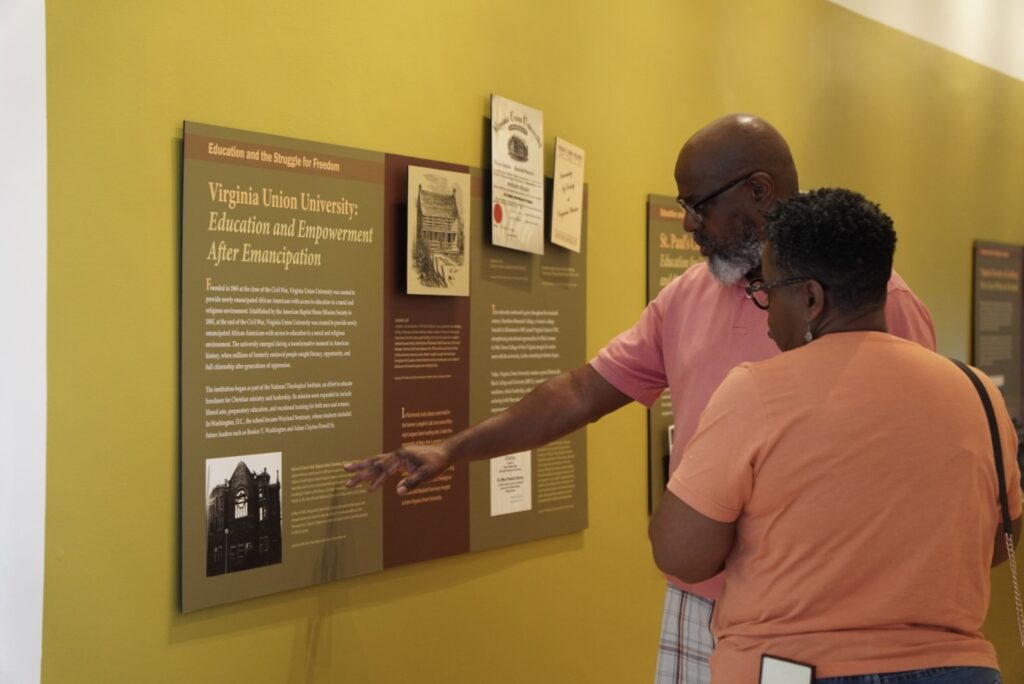
For much of our history, freedom for Black people has been promised in principle but denied in practice. It was those restricted rights and limited access to education that birthed Historically Black Colleges and Universities, another aspect of the exhibit.
Founded in the years following the Civil War, these institutions were created to educate newly emancipated Black citizens at a time when freedom didn’t mean equal access to schools, resources or opportunities. Virginia has five active HBCUs: Virginia Union University, Hampton University, Norfolk State University, Virginia University of Lynchburg and Virginia State University, the first fully state supported four-year public HBCU in the United States.
Granite neighborhood
“A Freedom Compromised” also looks at land, labor and the power of family, a subject that includes the Granite neighborhood on the Southside. For those whose only reference for Granite is the pool, the fact is that Granite was once a proud Black community. The Powhite Parkway now cuts through areas where farmers once tilled land and families built their lives.
Quarry workers from Granite, Virginia in about 1890, from the Valentine Museum’s Cook Collection.
Some of the longtime resident families — Howletts, Mickens, Carringtons and Greens, among many others — were formerly enslaved people from nearby plantations, while others settled in Granite after emancipation, hoping for opportunity, stability and the ever-elusive freedom. The men frequently worked in the nearby granite quarries while the women were domestic workers and housemaids.
It’s notable that Granite had everything it needed to be self-sufficient: schools, social clubs, restaurants, a drive-in movie theater, Granite Hill Baptist Church, cemeteries and even a baseball team. Black families who called Granite home didn’t need to leave to find fellowship, entertainment or support because the community provided for its own.
Yet how many people driving through Stratford Hills today, past the maze of big box stores and traffic lights, have any clue about the vibrant Black community that once stood there?
A visit to see “A Freedom Compromised: 250 Years of Black Life in Virginia” will take care of that and a whole lot more. The semiquincentennial celebration ignores that the Declaration of Independence didn’t mean equal access to freedom for all.
“A Freedom Compromised: 250 Years of Black Life in Virginia” through Dec. 19 at the Black History Museum, 122 W. Leigh Street. Blackhistorymuseum.org. The museum is open Wednesday to Saturday from 10 a.m. to 5 p.m.
