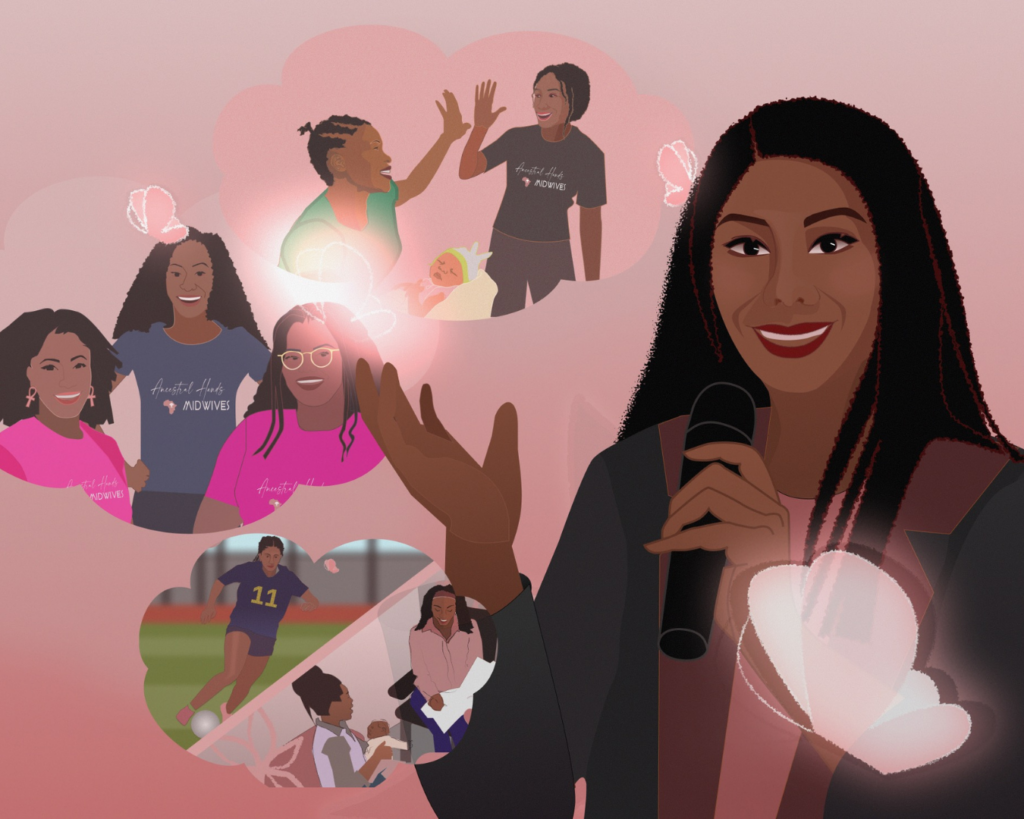
The Birth of Ancestral Hands Midwives
The realization that change was needed did not come from a single moment. Althea shares that it wasn’t one moment, rather, it was a pattern.
Story after story of traumatic birth experiences. Preventable complications. Women being told their pain tolerance was “high.” Young mothers navigating systems that treated them with suspicion rather than care. And when race-based data was available, it consistently revealed disproportionate risks for Black birthing people.
At some point, the pattern became undeniable. These were not isolated incidents. They were systemic.
“And since the system wasn’t going to transform itself,” Althea explains, “we would have to build parallel models that demonstrate what respectful, affirming care actually looks like.”
And this is when her initiative was born. Althea founded Ancestral Hands Midwives, a not-for-profit organization focused on improving the outcomes and experiences of Black people during the perinatal period.
The organization was created to address a gap that had long been overlooked: the absence of Black-led, racially concordant midwifery care in Ontario. Clients who come to Ancestral Hands are often seeking something that is surprisingly difficult to find within mainstream healthcare: culturally safe care delivered by providers who understand their experiences.
The difference is both clinical and relational.
Many Black mothers whom Althea and her team encountered in mainstream care described feeling unheard during appointments. Their concerns were minimized. Symptoms were doubted. Appointments were rushed, leaving little room for meaningful conversations or informed decision-making.
For some, the experience of navigating pregnancy care was fragmented and isolating. Others were excluded from midwifery services altogether due to high-risk classifications, leaving them to navigate complex hospital systems without consistent advocacy or support.
Underlying many of these experiences was a deeper issue: a profound lack of racially concordant care.
Many had never seen a provider who looked like them or understood the cultural context shaping their health, family dynamics, and fears.
“What people wanted was actually very simple: to be believed. To be respected. To be informed,” Althea shared.
Ancestral Hands was built to respond directly to that need.
The clinic’s model centers several core principles: racially concordant care, extended appointments that allow time for trust-building, trauma-informed approaches, and advocacy coaching so clients can navigate hospital and specialist systems with confidence.
The environment, both physical and relational, communicates something that is too often missing in healthcare spaces:
You matter here.
Althea describes the organization’s theory of change clearly: culturally safe, Black-led care can improve agency, safety, and outcomes and ultimately shift healthcare systems themselves when properly supported.