





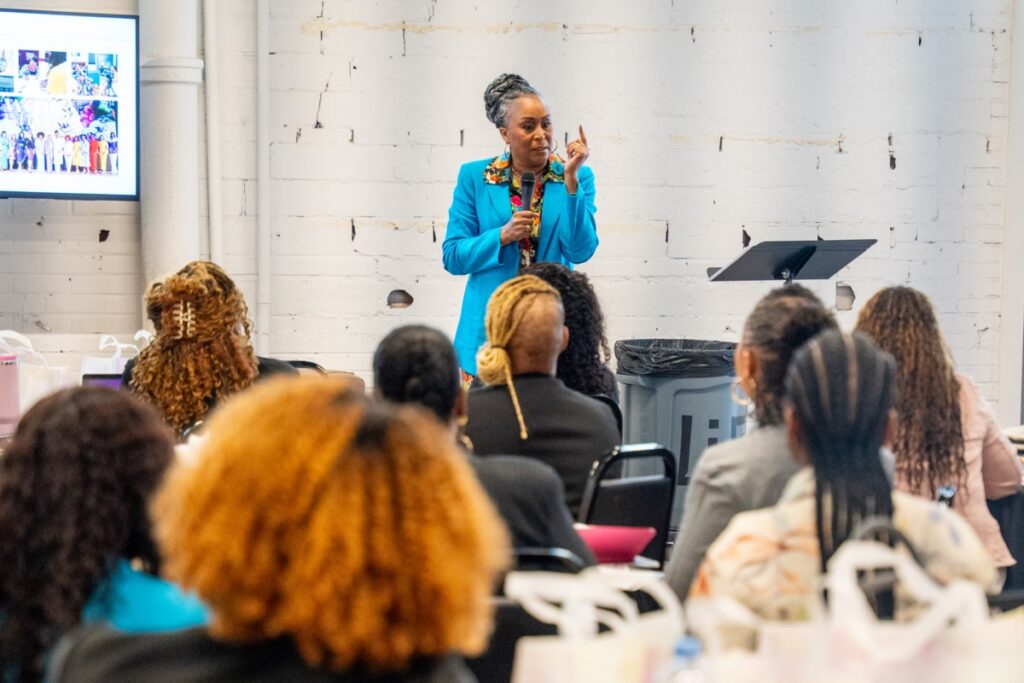
This month, Dr. Cheryl Polote Williamson will lead nearly 50 women entrepreneurs in intensive training focused on scaling their companies
North Texas has spent years selling itself as a national business powerhouse. But as corporate relocations pile up and startup culture expands across Dallas-Fort Worth, one question surfaces: who actually gets access to that growth?
That question sits at the center of the 2026 Soul Reborn Entrepreneur Incubator, a six-month program founded by Dr. Cheryl Polote Williamson and presented in partnership with Texas Capital. The nonprofit organization supports disadvantaged, disenfranchised and formerly incarcerated women through mentorship, entrepreneurship training and economic empowerment initiatives.
This year’s cohort brings together nearly 50 women entrepreneurs from across North Texas for intensive training focused on scaling their companies, building stronger infrastructure and preparing for long-term growth.
The numbers alone show the program’s potential reach. Collectively, the businesses in this year’s cohort generated roughly $3.15 million in revenue in 2025 and are projected to approach nearly $14.8 million in 2026. Together, the companies currently employ 82 people and expect to add another 56 jobs by the end of the year.
But for Polote Williamson, the incubator was never meant to only produce impressive statistics.
Why North Texas Became The Launchpad
Polote Williamson said building the incubator in North Texas was deliberate, not convenient. The region’s rapid economic expansion, corporate migration and startup activity created what she sees as both an opportunity and a risk for women founders, especially women of color.
“For women founders, especially women of color, that kind of momentum can either be a launchpad or a barrier depending on who has access,” Polote Williamson told Local Profile. “By rooting this incubator here, we’re making sure the women who already live, work and raise families in North Texas are positioned not just to participate in this growth, but to lead it.”
Photo: Soul Reborn
She believes North Texas offers something many larger coastal markets increasingly lack: accessibility. The surrounding region still offers room for expansion, along with a business culture Polote Williamson views as notably more collaborative and accessible than many larger coastal markets.
“Networks here are small enough to be personal but powerful enough to open real doors,” she said.
That ecosystem matters for founders trying to move beyond survival mode. The larger goal, Williamson said, is creating a pipeline of women-owned businesses that are built within North Texas and positioned to grow alongside the region’s expanding economy, rather than relying on outside companies to drive that growth.
Teaching Businesses How To Scale
Soul Reborn’s six-month structure focuses less on startup hype and more on operational discipline. The program’s next session, scheduled for May 23, will cover business entity structures, tax strategy, HR systems, payroll management and lending readiness. Texas Capital will also provide guidance on business banking and preparing for financing opportunities.
According to Polote Williamson, while 83% of participants already have business bank accounts, only 31% currently use professional payroll services. Just 35% leverage CRM systems, and 60% still rely on peer-to-peer payment platforms like Zelle, Cash App and Venmo for business transactions.
She noted that those gaps are often what separate businesses that plateau from businesses that grow.
“A scalable business has a clear value proposition, repeatable processes and a model that is not solely dependent on the founder’s time and energy,” she said.
Many businesses, she explained, remain trapped in day-to-day survival without documented operations, financial infrastructure or customer retention strategies capable of supporting larger growth.
“In the incubator, we focus on the unglamorous but essential building blocks of financial literacy — operations, automation and strategic planning — so that when these women get an opportunity, their businesses are ready to absorb growth,” Polote Williamson said.
Starting With Wellness Before Strategy
Rather than opening with spreadsheets or sales tactics, Soul Reborn began the cohort with a session centered on mindset, health and wellness. The first meeting saw a 96% attendance rate.
“You cannot build a sustainable business on top of burnout, trauma or complete self-neglect,” Polote Williamson said. “Many of the women we serve are the backbone of their families and communities; they’re often the first to show up for everyone else and the last to ask, ‘How am I really doing?’ If we skip that conversation and go straight to strategy, we’re building on a shaky foundation.”
Photo: Soul Reborn
Many of the women in the program, she noted, are balancing caregiving responsibilities, careers, religion and community leadership alongside entrepreneurship. Ignoring personal well-being, she said, often creates instability inside the business itself.
“Entrepreneurship will expose every insecurity, every limiting belief and every unhealed wound,” Polote Williamson said. “When women learn to protect their mental health, set boundaries and normalize rest, they make better decisions and lead their teams more effectively. Prioritizing wellness is not a luxury add-on; it’s a risk-management strategy for the business and a dignity-restoring practice for the founder.”
Building Opportunity During DEI Pullback
The incubator launches at a time when many corporate Diversity, Equity and Inclusion initiatives are shrinking nationwide. Polote Williamson believes that makes community-rooted programs even more important.
“We’re not waiting for national trends to decide whether women — especially Black and Brown women — deserve access to high-quality training, mentorship and networks,” she said. “We’re building that infrastructure ourselves and keeping it anchored in community.”
Black women remain one of the fastest-growing groups of entrepreneurs in the United States, owning nearly 15% of women-owned businesses and more than half of all Black-owned businesses. Yet many still face significant barriers to funding, mentorship and institutional networks.
Polote Williamson said the national data often misses the full reality she sees firsthand.
“Many are funding their businesses through personal savings, revenue and informal networks because traditional doors keep closing,” she said. “Yet they keep innovating.”
She also sees founders asking different questions than they once did.
“They’re not just asking, ‘How do I start?’” Polote Williamson said. “They’re asking, ‘How do I own my IP? How do I hire my first employee? How do I get in the room with institutional capital?’ That evolution in mindset isn’t always reflected in national data, but it’s happening in rooms like ours every day.”
A Bigger Goal Than Revenue
The incubator is backed by a network of partners, including Intuit, Penguin Random House, The T.D. Jakes Foundation and the Southern Black Girls and Women’s Consortium.
Over the next six months, participants will receive training in branding, public relations, technology and funding strategy while building relationships with mentors and fellow founders.
But Polote Williamson says the long-term vision reaches far beyond individual businesses.
“I want it to be ordinary, not exceptional, to see Black and Brown women leading companies that create jobs, secure major contracts and sit at the center of regional supply chains,” she said.
And that’s only the beginning. For her, success ultimately looks like something larger than startup growth.
As North Texas grows as a business hub, Williamson is urging leaders and corporations to move beyond symbolic support and focus on measurable investment, including procurement goals and real access to contracts and capital for women-owned businesses.
“If we align public policy, corporate procurement, and community-based incubation, North Texas can become not just a big business hub, but a fair one,” Polote Williamson said. “That’s the kind of ecosystem where women entrepreneurs do more than survive; they scale, they hire and they help shape the future of this region.”
Don’t miss anything Local. Sign up for our free newsletter.
